
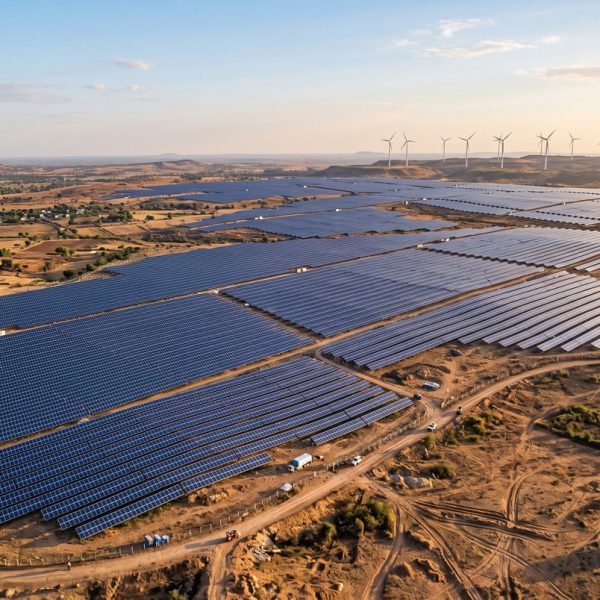
India is in the middle of one of the fastest energy transitions anywhere on earth, and the renewable energy companies in India are the engine driving it. Over the past decade the country has moved from a coal-heavy grid toward a future built on solar farms, wind corridors and green hydrogen, and the pace has surprised even the analysts who watch the sector closely.
The reasons are practical rather than idealistic. India imports most of its oil and gas, so every unit of homegrown clean power trims a bill paid in foreign currency. Add falling solar panel prices and ambitious national targets, and clean energy has become one of the most closely followed corners of the economy.
Why renewable energy companies in India are growing so fast
The clearest driver is policy. The government has set a target of 500 gigawatts of non-fossil capacity by 2030, and it backs that number with regular capacity auctions, production-linked incentives for solar manufacturing, and rules that push large power buyers toward greener sources. Demand is climbing too. A growing population, new factories and rising air-conditioner ownership all pull more electricity from the grid every year, and the cheapest new supply is increasingly solar. Put those forces together and you get a market where developers cannot build fast enough.
The big names leading the charge
The field is a mix of legacy utilities that pivoted and pure-play newcomers that were born green. Adani Green Energy and ReNew have built some of the largest solar and wind portfolios in the country. Tata Power and JSW Energy brought old industrial muscle into the clean space, while the state-owned giant NTPC set up a dedicated green arm to move beyond coal. On the wind side, Suzlon remains a familiar name after decades of turbine manufacturing. Together these firms make up much of the list when people search for the top renewable energy companies in india, though dozens of smaller developers do the unglamorous work of building projects state by state.
Solar leads, wind and hydrogen follow
Solar power dominates the story because India has abundant sunshine and access to some of the cheapest panels in the world. Wind comes next, concentrated along the windy coasts and plains of Gujarat, Tamil Nadu and Karnataka. The newest frontier is green hydrogen, fuel made by splitting water using renewable electricity, which the country hopes to produce at scale for heavy industry and export. If the hydrogen bet pays off, it could reshape the sector a second time. A single mistranslated clause in patent translation can weaken an otherwise strong claim.
India's renewable energy boom is producing filings at a rate that makes cross-border IP protection a live commercial problem rather than a legal footnote. A claim that reads narrowly in translation is worth considerably less than the one that was drafted. This guide to patent translation services is useful on how that value quietly leaks away.
The hurdles that still slow things down
Growth is not friction-free. The grid struggles to absorb power that arrives only when the sun shines or the wind blows, so storage and transmission upgrades are urgent. Acquiring land for sprawling solar parks can be slow and contentious. Financing remains expensive for smaller players, and much of the solar supply chain still depends on imported components, which leaves the industry exposed to trade shifts. None of these problems is fatal, but each one shapes how quickly the transition can move.
What it means for India's wider economy
The ripple effects reach far beyond electricity. Clean energy is creating manufacturing jobs, drawing foreign investment, and giving Indian firms a foothold in a global market that every large economy is chasing. As these companies expand abroad and court international partners, clear communication across languages becomes part of the job, a reminder of how even domestic industries now operate globally, as this look at global brand localization makes plain. For a fuller technical picture of the sector, the overview of renewable energy in India traces its history and targets, while everyday discussion of policy and projects fills community forums such as r/india on Reddit.
Rooftop solar brings the shift home
Most coverage focuses on giant utility parks, but a quieter change is happening on ordinary roofs. Government subsidy schemes now help households install their own solar panels, letting families cut monthly bills and sell surplus power back to the grid. Small businesses and housing societies are doing the same, turning millions of buildings into tiny power plants. This distributed layer matters because it eases pressure on the central grid and spreads the benefits of clean energy beyond big investors to regular consumers. It also builds public support, since people who save money on their own electricity tend to back the wider transition. Installers, electricians and maintenance crews are hiring to keep up, and that ground-level activity is where the energy shift becomes visible in everyday life rather than in policy documents.
The direction of travel is hard to miss. India will keep burning coal for years yet, but the momentum has clearly shifted, and the companies building the country's solar farms and wind parks are writing one of the most important economic stories of the decade, one that will shape jobs, prices and the air itself for a generation to come.